- July 2, 2026
- Posted by: admin
- Category: BitCoin, Blockchain, Cryptocurrency, Investments
France’s crypto security problem is expanding beyond private keys to include the people whom attackers can identify, threaten, and force to authorize transfers.
Interior Minister Laurent Nuñez said French authorities have recorded 77 cases this year involving unlawful confinement, abduction, extortion, or attempted extortion tied to crypto-sector actors, according to <a href=”https://www.bfmtv.com/crypto/cryptomonnaies-laurent-nunez-promet-de-renforcer-la-securite-des-acteurs-du-secteur_AD-202606300994.html”>BFM TV</a>.
Le Parisien, in a report published with AFP, said the figure compares with 45 cases across 2025, giving the new total a clear reference point.
The increase is pushing France beyond the familiar playbook of cold storage, seed phrases, and wallet hygiene.
Nuñez said 200 people had been arrested either after incidents or in anticipation, while 724 crypto-sector participants had been enrolled in immediate-identification systems intended to help emergency services recognize high-risk individuals more quickly. The plan he described points to a different kind of crypto security model: intelligence sharing, an expert network linking the industry and the state, and tighter operational cooperation between French services and foreign jurisdictions where organizers may be based.
France is becoming a test case for a problem the industry has often treated as peripheral. Public wealth, liquid assets, leaked personal data, and online visibility can turn crypto ownership into a physical-security exposure for founders, executives, public investors, employees, families, and high-profile holders.

France’s new numbers change the risk model
The headline figure marks the point at which French authorities are treating crypto-linked coercion as a recurring organized-crime problem.
| Figure | What it measures | Why it changes the response |
|---|---|---|
| 77 | Crypto-linked sequestration, kidnapping, extortion, or attempted extortion cases reported this year | Shows the threat has become frequent enough to drive a dedicated state response |
| 45 | Comparable cases recorded in 2025 | Gives the new figure a year-over-year reference point |
| 200 | People arrested after incidents or in anticipation | Shows police are trying to disrupt networks before attacks occur |
| 724 | Crypto-sector beneficiaries registered on immediate-identification platforms | Shows the response is becoming operational |
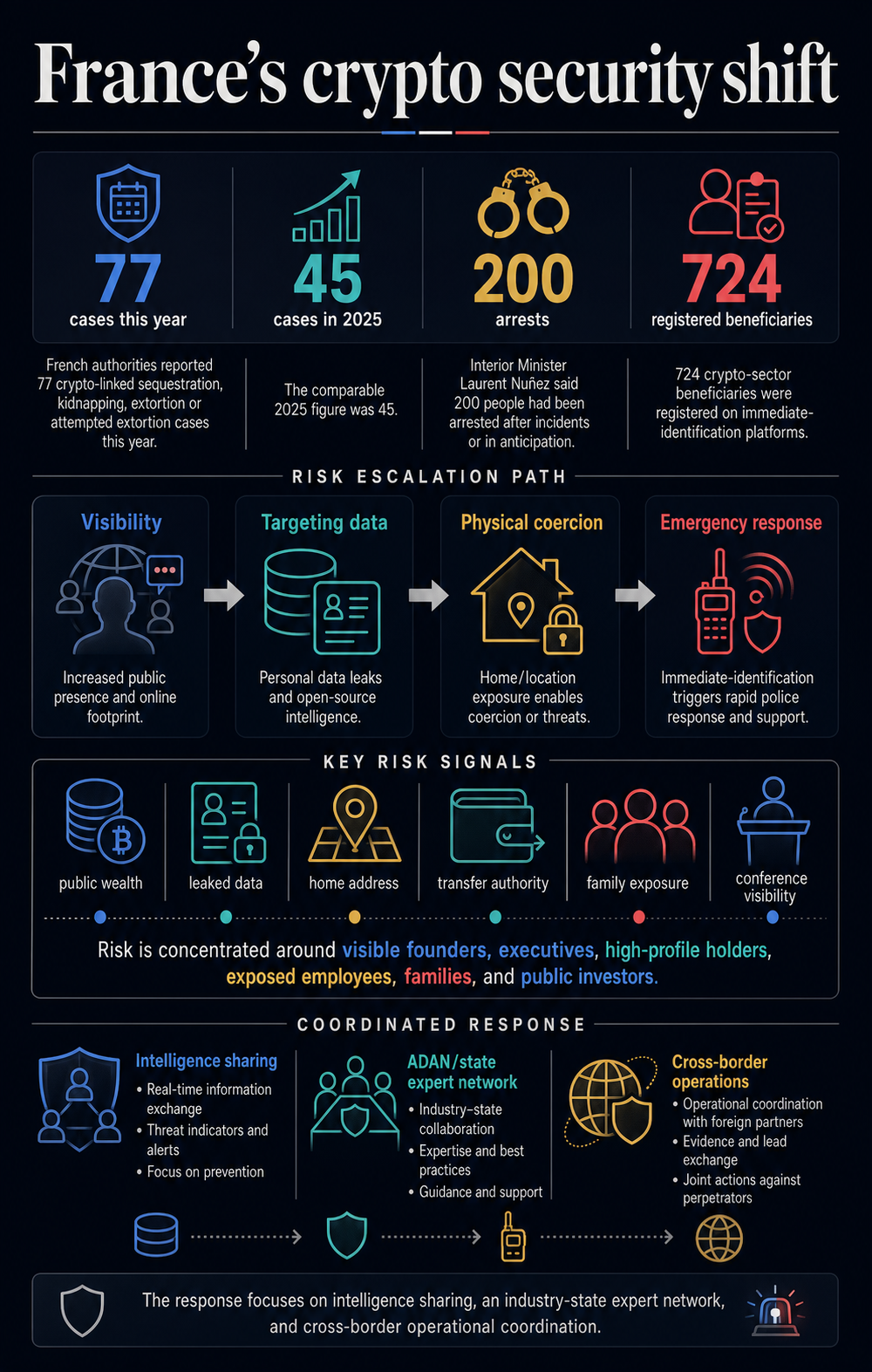
The attack surface now includes more than an exchange, a smart contract, or a wallet. The person behind an account can become the attack surface.
A founder whose address is exposed, an employee whose role is visible, or a major holder whose wealth is signaled online may face risks that software controls alone cannot absorb.
The risk boundary is still tighter than broad crypto ownership. The French figures and official response are centered on crypto-sector actors and exposed people.
The practical takeaway is targeted: firms and visible holders need to treat personal information, travel patterns, public appearances, home addresses, and emergency-response channels as part of their security posture.
Crypto security culture has long focused on preventing unauthorized digital access. Hardware wallets, multisig, withdrawal delays, and custody controls all reduce the chance that a remote attacker can drain funds without consent.
Physical coercion changes the problem. Once criminals identify a person with access, the technical barrier becomes one layer of defense among several.
The aim is to pressure, threaten, or detain someone who can authorize a transfer.
That dynamic explains why the French plan leans toward intelligence and coordination. Le Parisien reported that Nuñez described three axes: reinforced intelligence sharing, a deeper partnership with ADAN through a network of experts from the sector and relevant state agents, and stronger operational coordination among services and with countries where organizers may be present.
France is building a police-industry bridge
The French approach treats attackers as networks first and opportunists second. It also assumes that the useful data may sit outside the blockchain: addresses, family links, executive roles, social media trails, leaked customer records, company filings, conference attendance, and information about who has authority to move assets.
Crypto’s public ledgers can help investigators trace stolen funds. Blockchain visibility still cannot prevent coercion before it starts.
Chainalysis has warned in its 2026 Crypto Crime Report introduction that physical coercion and violence are increasingly intersecting with on-chain activity as criminals force victims to transfer assets.
CertiK separately reported 72 verified physical coercion incidents worldwide in 2025, up 75% from 2024, with kidnapping as the primary vector and physical assaults up 250%.
Methodologies differ between security researchers and French officials, so the figures should sit beside each other as context instead of a direct comparison.
They still point in the same direction: crypto wealth is creating a risk category that sits between cybercrime, organized crime, executive protection, and financial intelligence.
France had already begun building a crypto-sector protection framework before the latest figures.
In May 2025, the Interior Ministry said after meeting sector actors that measures would include priority emergency access, home-security audits for exposed people, briefings by elite units including GIGN, RAID, and BRI, a cybercrime contact point, and an ADAN-linked working group.
The June 30 update suggests that architecture is becoming more formal. Immediate-identification platforms are meant to give registered high-risk people a faster way to be recognized by emergency services.
Intelligence sharing is meant to help authorities move from reacting to attacks toward mapping organizers and logistics. Cross-border coordination has become central because commanditaires, recruiters, or handlers may be outside France.
The kidnapping of Ledger co-founder David Balland showed why that blend matters.
The Gendarmerie described a response involving judicial organized-crime coordination, GIGN deployment, cyber specialists, crypto ransom tracing and freezing, and more than 230 gendarmes.
That is a full law-enforcement operation in which the digital asset and the physical victim are part of the same case.
France has also begun addressing the data-exposure side of the problem. A 2025 decree published on Légifrance allows company officers and indefinitely liable partners to request that personal home addresses be kept confidential in company registry filings.
Although broader than crypto, the measure speaks directly to one of the mechanisms that can make executives and entrepreneurs easier to target.
The next security layer is operational
For the crypto industry, the implication is practical and uncomfortable. A firm can have strong custody controls and still expose people through public records, staff profiles, predictable routines, conference schedules, or weak internal escalation procedures.
That makes physical security and data minimization operational issues for any business with exposed leadership or staff who can authorize movement of funds.
Companies may need clearer threat models for who can authorize transfers, who appears in public materials, what information is available about family members or home addresses, and how quickly they can reach law enforcement if a threat emerges.
The same applies to high-profile holders and influencers, though the risk is unevenly distributed. Public status, visible wealth, and identifiable location data create a different exposure profile from simple asset ownership.
The more an attacker can connect a person, an address, a role, and an assumed balance, the less the threat looks like generic crypto crime and the more it looks like targeted extortion.

CryptoSlate has previously covered the rise in physical wrench attacks and the way France became a focal point for violent targeting.
The new development is that French officials are now describing an expanded response around numbers, registration systems, intelligence flows, and international coordination.
That is the signal to watch. If the French approach works, the next phase of crypto security may look less like a wallet tutorial and more like the risk programs used in banking, executive protection, and organized-crime investigations.
If it fails, attackers may keep adapting through proxies, foreign organizers, leaked data, and lower-level recruits who can be replaced after arrests.
The market’s security frontier is moving offline. For visible crypto operators, the next test is whether enough personal, corporate, and law-enforcement infrastructure exists to stop digital wealth from becoming a physical target.
The post France’s crypto kidnapping surge exposes the personal data trail behind wrench attacks appeared first on CryptoSlate.