- September 14, 2026
- Posted by: admin
- Category: BitCoin, Blockchain, Cryptocurrency, Investments

India’s securities regulator has launched a pilot that places corporate bonds and their cash settlement on linked digital rails, moving ₹1,025 crore through the first three issuances while preserving the securities’ existing legal and economic terms.
The Securities and Exchange Board of India announced Demat 2.0 on Sept. 10 after REC Limited, L&T Limited and IIFL completed tokenized bond issues on Sept. 7 and Sept. 9. The transactions comprised ₹500 crore from REC, ₹500 crore from L&T and ₹25 crore from IIFL, according to SEBI’s release. Further Stage I issuance is ongoing.
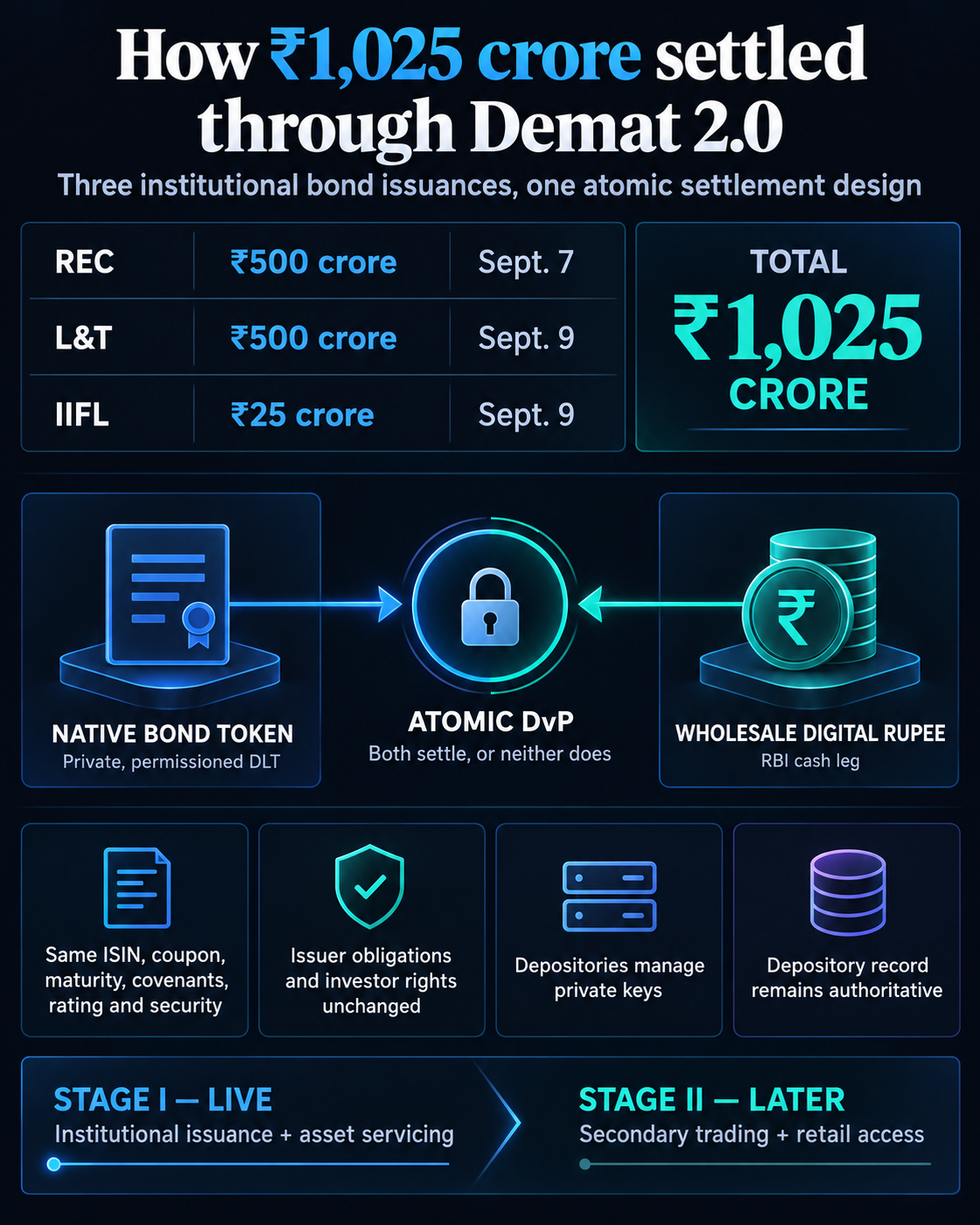
The central change is how the security and payment meet. A corporate bond is issued as a native digital token on a private, permissioned distributed ledger, while payment uses the Reserve Bank of India’s wholesale digital rupee, a central bank currency designed for financial institutions.
SEBI’s technical FAQ says the two legs are linked for atomic delivery-versus-payment. Either the bond and cash both settle, or neither does. That synchronization removes the interval in which a buyer could send funds before receiving the security, or a seller could deliver the bond before receiving payment. Issuer credit risk remains unchanged.
The token is the bond itself, rather than a digital claim on a conventionally held security. It keeps the same ISIN identifier, coupon, maturity, covenants, rating and security as a conventional dematerialized bond. Issuer obligations, investor rights and regulatory treatment also stay the same.
The network is private and institutionally controlled. India’s depositories own it and remain the statutory, authoritative records of beneficial ownership. Market infrastructure institutions developed and operate the system, with depositories and stock exchanges initially running the network’s validating computers. Depositories also hold and manage investors’ private keys, preserving an intermediated custody model.
That structure leaves the familiar custody chain in place. Investors gain access to the tokenized ledger without managing the bond tokens’ private keys or replacing the depository record that establishes ownership.
Secondary trading comes later
The live first stage covers institutional issuance and ledger-based asset servicing. SEBI reserves tokenized secondary-market trading and retail participation for Stage II.
During the interim, an investor may exit through a peer-to-peer or demat-to-demat transfer handled by depositories. Payment for that transfer may occur outside the atomic setup through the digital rupee or conventional banking channels.
The first deals show how regulated securities records and central bank money can be synchronized at issuance. The larger test for Stage II is whether the same architecture can support routine liquidity and a broader investor base after the bond has been issued.
The post India’s tokenized bond pilot starts with institutions, with retail access planned next appeared first on CryptoSlate.