- March 10, 2026
- Posted by: admin
- Category: BitCoin, Blockchain, Cryptocurrency, Investments
Bitcoin continues to struggle to reclaim the $70,000 level as volatility persists across the cryptocurrency market. After several attempts to recover from recent declines, price action remains fragile, reflecting a market environment where investors are still adjusting to shifting macro conditions and weakening momentum. As Bitcoin trades near the mid-$60,000 range, on-chain indicators suggest that selling pressure from short-term participants remains a key factor influencing the market structure.
According to analysis shared by on-chain analyst Axel Adler, recent data shows that short-term holders are continuing to realize losses at a sustained pace. The Bitcoin Short-Term Holder Spent Output Profit Ratio (STH SOPR) has remained below the neutral threshold of 1.0 for seven out of the last eight days. This metric compares the selling price of recently moved coins to their original purchase price, meaning readings below 1.0 indicate that investors are selling at a loss.

Between March 2 and March 9, STH SOPR crossed above 1.0 only once, briefly on March 4 when Bitcoin touched around $70,800. For the rest of the period, the indicator remained in loss-selling territory, with the weekly low recorded at 0.979 on March 6. As of March 9, the intraday average stands near 0.987, confirming persistent selling pressure among recent market entrants.
Short-Term Holder Supply Continues To Contract
The report also highlights important developments in the behavior of Bitcoin’s short-term holders, particularly through changes in the Short-Term Holder (STH) Supply metric. This indicator measures the total amount of BTC held by investors whose coins are younger than 155 days, offering insight into the activity of more reactive market participants.

Over the past two weeks, STH Supply has declined noticeably, falling from approximately 6.06 million BTC to around 5.92 million BTC. This represents a reduction of roughly 140,000 BTC within the cohort, signaling that a significant number of coins have either been sold or transitioned into longer holding periods. At the same time, the realized price of this group remains near $89,028, while Bitcoin’s market price is trading closer to $67,175.
This roughly 24% gap highlights the magnitude of unrealized losses currently affecting short-term holders. Such conditions often create psychological pressure, as investors who entered the market at higher prices face extended periods of negative returns.
The decline in STH Supply can reflect two parallel processes. In some cases, it represents capitulation as investors sell at a loss. In others, it reflects the natural maturation of coins into long-term holding categories. However, the large difference between realized price and market price suggests a potential supply overhang, as some holders may sell during future rallies to exit positions without losses.
Bitcoin Holds $67K After Sharp Correction From Cycle Highs
The 3-day chart shows Bitcoin trading near the $67,800 region after a sharp correction from the late-2025 highs above $120,000. The market structure shifted decisively at the start of 2026 when BTC lost momentum near the $110,000–$115,000 range and began forming a series of lower highs. This transition signaled a weakening trend and triggered an accelerated decline once price broke below the 50-period moving average (blue).
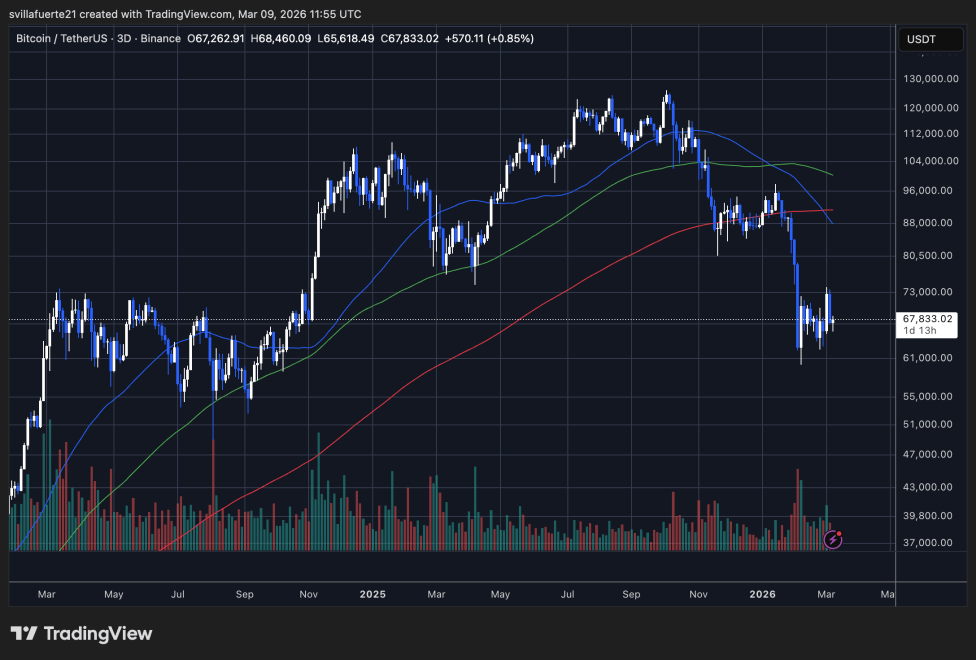
Selling pressure intensified during the first quarter of 2026, pushing Bitcoin quickly through the 100-period moving average (green). The breakdown confirmed a broader shift toward a corrective phase and eventually drove BTC toward the $62,000–$65,000 support area before buyers stepped in to stabilize price action.
Currently, Bitcoin is attempting to consolidate between $65,000 and $70,000, a range that now represents a critical short-term equilibrium zone. The 200-period moving average (red), positioned around the $88,000 region, remains far above the current price and acts as a major resistance level that bulls would need to reclaim to restore stronger long-term momentum.
Volume activity increased during the recent decline, suggesting that the correction involved significant distribution. For Bitcoin to reestablish a bullish structure, price would likely need to recover the $70,000–$75,000 range and reclaim the shorter moving averages.
Featured image from ChatGPT, chart from TradingView.com