- May 12, 2026
- Posted by: admin
- Category: BitCoin, Blockchain, Cryptocurrency, Investments
Bitcoin is pushing toward $82,000 as the market builds momentum and buyers test resistance that has held through multiple previous attempts. The price action is constructive — but analyst Axel Adler has published a study of the realized profit and loss data that provides the most precise available picture of where Bitcoin actually stands in its recovery cycle, and the finding is both encouraging and honest about what remains unresolved.
The metric Adler examines tracks the 30-day ratio of realized profits to realized losses — a measure of whether the market is dominated by participants selling at a gain or at a loss. When that ratio falls below 0.5, realized losses are outpacing profits by at least two to one. That is the panic selling zone — the regime in which fear drives holders to exit at any price, regardless of their cost basis.

Bitcoin entered that zone on February 5, 2026. It reached its most extreme point on February 21, when the ratio fell to 0.26 — meaning losses were outpacing profits by nearly four to one at the depth of the capitulation. The panic selling zone persisted until March 21.
By May 10, the ratio had recovered to 1.13 with Bitcoin holding around $80,000. The market is no longer in forced loss-taking mode. The capitulation phase that defined the February and March period is over. What that exit means — and what it does not yet mean — is the analytical question Adler’s study addresses directly.
The Panic Is Over. The Capital Has Barely Started Coming Back
Adler’s second metric is where the honest calibration of the current recovery becomes most precise. The Realized Cap Net Position Change tracks the 30-day average of daily changes in Bitcoin’s realized capitalization — a measure of whether new capital is entering the network in aggregate or whether the capital base is contracting. A positive reading means expansion. A negative reading means the network’s realized value is still declining.

In February 2026, the metric reached a low of -0.087% on February 20 — capital was leaving the network at a meaningful and sustained pace. It crossed back above zero on May 2, formally ending the contraction phase. By May 10, the reading stood at +0.008%.
Adler places that figure in the historical context that gives it its full meaning. The March 2024 expansion peak reached +0.534%. The December 2024 peak reached +0.472%. The current +0.008% reading represents a recovery that is roughly 98% weaker than either of those strong phases — a return to positive territory that is technically correct but structurally minimal.
The two charts together form the complete picture of where Bitcoin stands. The first confirms that panic selling is finished — the capitulation regime that lasted from February 5 to March 21 has ended. The second confirms that the capital inflows required to drive a genuine expansion phase have not yet arrived at a meaningful scale.
The current regime is in recovery after capitulation. It is not yet a broad capital expansion. Those are meaningfully different conditions — and the distance between them is what the next phase of Bitcoin’s market structure must close before the recovery becomes something more than a technical exit from the worst.
Bitcoin Tests Resistance As Recovery Momentum Slows
Bitcoin continues consolidating just above the $80,000 level after a strong recovery from the February capitulation lows near $60,000. The broader structure remains constructive, with BTC maintaining higher lows throughout the recovery phase and holding comfortably above the rising 50-day moving average near the $73,000 region.
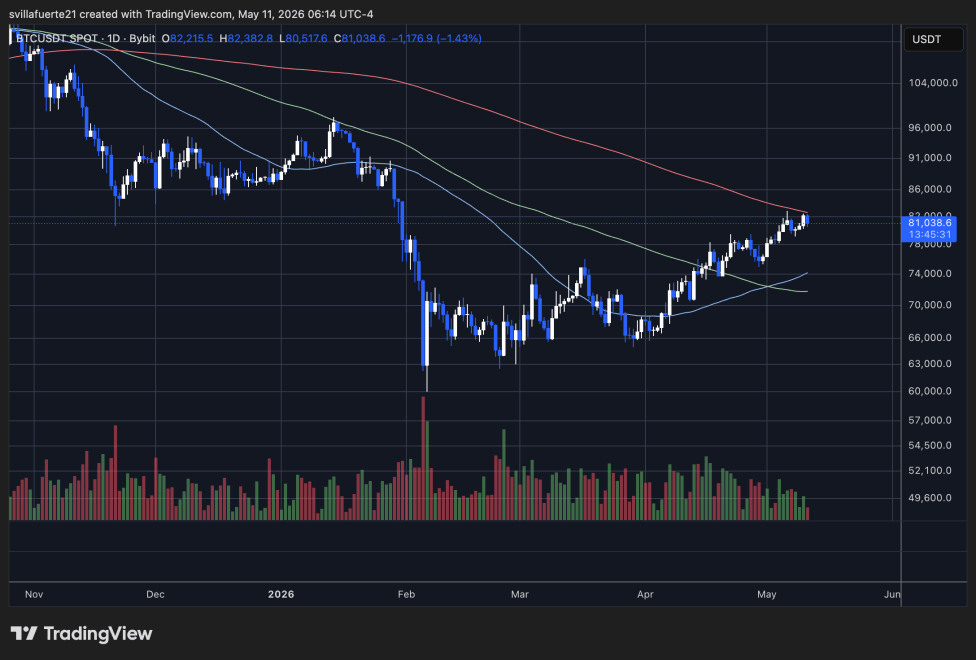
However, the chart also shows momentum beginning to slow as price approaches a major resistance cluster between $81,000 and $83,000. This zone aligns closely with the declining 100-day moving average, which has rejected multiple breakout attempts during the past several weeks. The inability to reclaim that level decisively suggests that sellers remain active into strength despite the broader recovery.
Volume trends reinforce the consolidation narrative. Participation has declined compared to the aggressive rebound phase seen in March and April, indicating that the market is entering a temporary equilibrium after weeks of directional upside. This moderation in activity reduces immediate volatility but also means stronger spot demand may be required to sustain another leg higher.
Importantly, Bitcoin has not shown signs of structural weakness despite repeated rejections near resistance. Buyers continue defending pullbacks above the 50-day moving average, preserving the sequence of higher lows that defines the current uptrend.
A confirmed breakout above the $82,000 resistance zone could expose the $86,000–$90,000 range. Failure to maintain support above $78,000 would likely shift momentum back toward consolidation or a deeper retracement.
Featured image from ChatGPT, chart from TradingView.com