- September 30, 2026
- Posted by: admin
- Category: BitCoin, Blockchain, Cryptocurrency, Investments

Stablecoin card spending is accelerating to record levels, but the payment rail remains a fraction of the traditional card market.
Paymentscan tracked about $1.17 billion in spending through Sept. 30, already above August’s completed total and the highest monthly figure in its displayed series.
Cuy Sheffield, head of Visa’s crypto unit, described stablecoin-linked cards as being in “hyper growth mode,” as issuers increasingly connect dollar-denominated tokens to existing card networks rather than wait for merchants to accept crypto directly.
Notably, the growth has continued even without a corresponding increase in payment frequency. Paymentscan recorded 11.0 million transactions in September, down from 11.07 million in August, lifting the implied average transaction size to about $107.
Active addresses also slipped to 283,761 from 287,634, though that measure is incomplete. Paymentscan counts addresses rather than individual users, and RedotPay, the market’s largest tracked program, does not report an active-address figure on the platform.
That leaves September showing a market handling more money through fewer recorded payments, at least before the month closes.
Base leads chain activity as RedotPay dominates card programs
Coinbase-backed Base has emerged as the largest blockchain venue for stablecoin card spending, while RedotPay remains the biggest card program by volume.
Paymentscan’s on-chain-only data showed $788.9 million of September spending across tracked networks. Base accounted for $216.8 million, or 27.5% of the total, followed by Optimism at $127 million and Solana at $109.3 million.
Stellar processed $69.3 million, Polygon $50.9 million, and Ethereum $49.5 million, while Plasma contributed $38.3 million. Another $127.8 million was spread across 11 other chains.
Those figures cover on-chain spending and differ from Paymentscan’s broader $1.13 billion September total, which can also include issuer-supplied off-chain, clearing, or settlement data depending on the program.
At the card-program level, RedotPay was the clear leader, with $401.9 million in spending over the latest 30-day period, equivalent to about $4.9 billion annualized. EtherFi ranked second with $127.4 million, or about $1.5 billion annualized, followed by KAST at $113.1 million, or $1.4 billion.
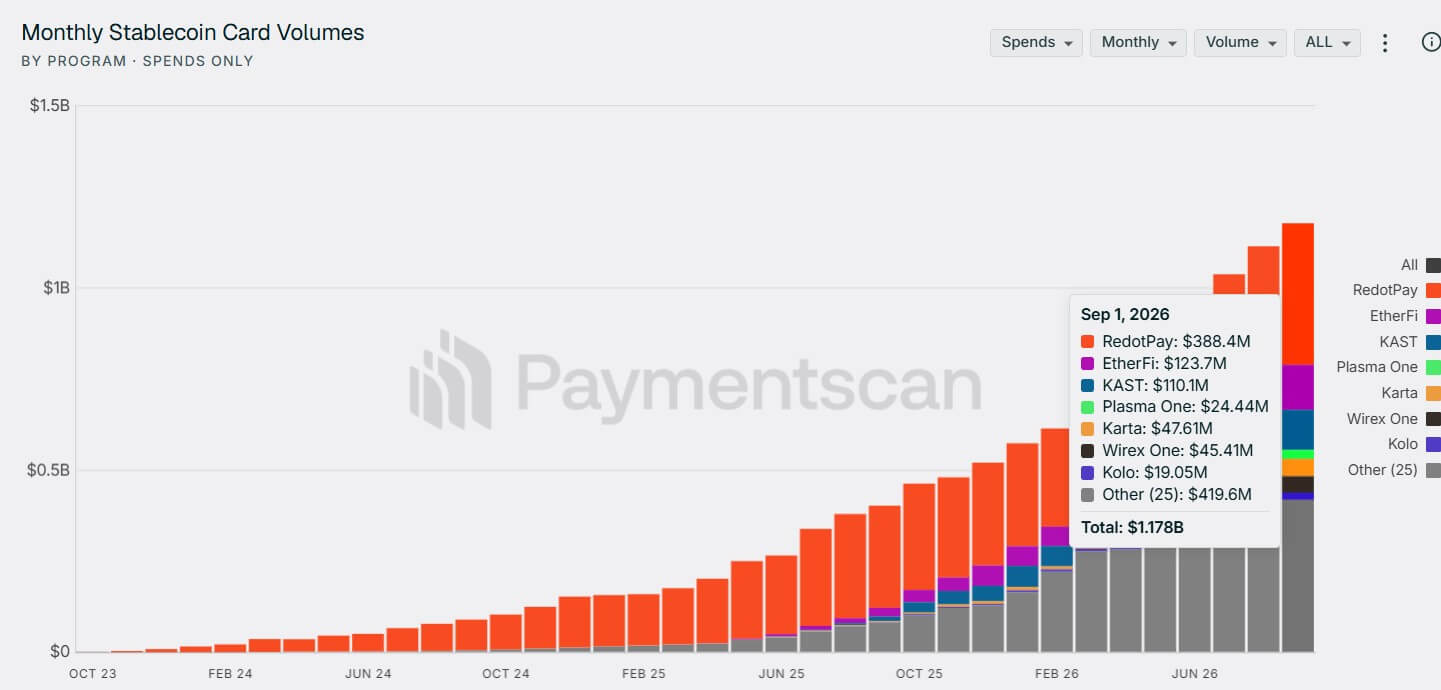
Karta and Wirex One rounded out the top five, with $48.7 million and $46.9 million of 30-day volume, respectively. Their annualized run rates stood at about $592.8 million and $570.4 million.
Growth was uneven across the group. RedotPay’s 30-day volume was up 3%, while EtherFi rose 20.3%, KAST gained 11.1%, Karta increased 14.4% and Wirex One climbed 40.1%, according to Paymentscan.
In view of this growth, Tiger Research argues the more important question is whether crypto-card providers can convert this development into a durable financial relationship.
Like debit cards before their commercialization in the 1990s, crypto cards can ride existing payment networks and avoid the merchant-acceptance bottleneck. But salary deposits, recurring expenses, and primary-account relationships remain largely outside their control.
That leaves the next phase of competition focused less on headline payment volume and more on whether issuers can capture everyday financial activity in markets where banks and global payment firms have yet to match that reach.
The post Stablecoin cards enter ‘hyper growth’ mode as monthly spending hits record $1.17 billion appeared first on CryptoSlate.