- July 6, 2026
- Posted by: admin
- Category: BitCoin, Blockchain, Cryptocurrency, Investments
Vitalik Buterin’s July 4 Lean Ethereum post put a clock on ETH’s institutional story: a protocol pitched as financial infrastructure now has to show it can rebuild itself in public.
In a weekend post on X, Buterin described Lean Ethereum as a three- or four-year collection of upgrades and called it Ethereum’s third major iteration, after the Merge.
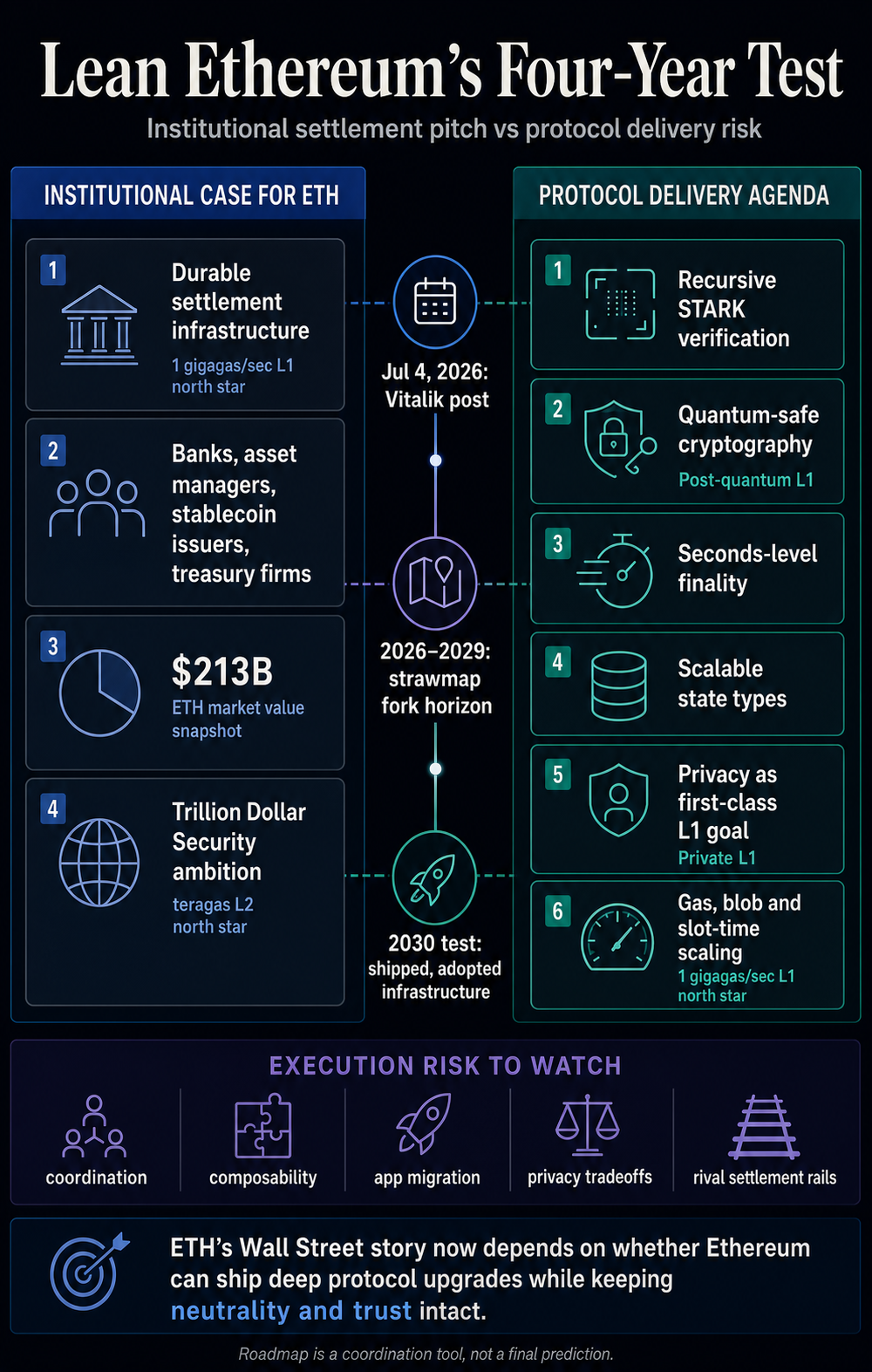
The accompanying EF Architecture strawmap frames itself as a strawman coordination tool, rather than a final prediction. Its north stars are still large: seconds-level finality, 1 gigagas/sec on L1, teragas-scale L2 capacity, post-quantum security, and privacy as a first-class L1 goal.
That framing hardens the investment question around ETH. Institutions are being asked to believe that Ethereum can become durable financial plumbing while a decentralized protocol redesigns major parts of itself over several years. The settlement assurances that make Ethereum attractive in the first place now have to survive the transition.
The Institutional Pitch Meets Protocol Change
Ethereum’s Wall Street moment has already been moving beyond spot-market access. That pitch now reaches banks, asset managers, stablecoin issuers, tokenization desks, and public companies that treat ETH as a balance-sheet asset or Ethereum as settlement infrastructure.
The Ethereum Foundation’s 2025 Trillion Dollar Security initiative framed that ambition directly. Ethereum wants to become infrastructure secure enough for individuals, companies, institutions, and governments to hold very large amounts of value on-chain.
That is the institutional promise Lean Ethereum now has to serve.

The timing is not accidental. Ethereum Institutional launched as a corporate front door for banks, asset managers, public companies, tokenization, and stablecoins, while Ethlabs emerged as a treasury-backed R&D layer tied to the ETH monetary case.
Bitmine, Sharplink, and Joe Lubin sit behind both efforts, creating a new external stack around Ethereum’s institutional push while the Foundation tries to preserve a neutral protocol role.

That context makes Lean Ethereum more than a technical wish list. If ETH is to be sold as durable settlement collateral, the roadmap has to reduce uncertainty rather than add a new kind of it.
CryptoSlate market data on July 5 showed ETH trading near $1,763, with a market value of roughly $213 billion. The asset is large enough for protocol direction to matter, but still exposed enough for institutions to care about execution risk.
For banks and treasurers, this is a different due diligence problem from buying an asset with a volatile chart. They need to judge whether the base layer’s next architecture can keep settlement predictable while applications, wallets, clients, L2s, and privacy tooling adjust around it.
A strong roadmap helps only if it produces a credible path from today’s Ethereum to a more scalable and secure version of the same neutral network. That is the terrain Lean Ethereum now enters.
Why The Upgrade Stack Matters
Buterin’s post grouped Lean Ethereum around several changes that are easy to miss if they are dismissed as research jargon.
Recursive STARKs would shift verification away from direct re-execution and toward proofs that can make checking the chain cheaper and more scalable. For institutions, that goes to confidence in the system’s auditability and long-run operating cost.
Quantum-safe cryptography is a different kind of bet. It addresses whether assets and applications meant to live for decades can rely on signature and proof systems that will age well. The strawmap’s post-quantum L1 north star makes that a protocol-level concern.
The finality and gas-limit pieces are more immediately operational. Faster finality changes how quickly a transaction can be treated as settled.
Repeated gas-limit increases, blob increases, and shorter slot times affect how much activity Ethereum can absorb without pushing users and applications elsewhere. The strawmap’s gigagas L1 and teragas L2 goals are ambitious, but the institutional read is straightforward: if Ethereum wants to carry more settlement flow, it has to make capacity feel less scarce.
State is the most disruptive part of the plan because it touches application design. Buterin described a future in which today’s dynamic state remains, but grows only moderately, while new state types scale much further with tighter design constraints.
That could make ERC-20s, NFTs, and many DeFi use cases cheaper if they adapt, while more complex shared contracts continue to rely on dynamic state.
That makes the state plan a migration-incentive story. If new state designs can materially lower fees for common assets, application developers will have reason to move.
If those designs fragment liquidity, composability, or developer expectations, the savings come with tradeoffs. This is where the institutional settlement case becomes as much a product and governance problem as a cryptography problem.
Privacy sits in the same category. Buterin said privacy is now a first-class goal, and the strawmap lists private L1 as one of its north stars.
For institutional workflows, privacy is an operating requirement. Banks and asset managers need confidentiality, compliance controls, and predictable settlement.
Ethereum also has to preserve public verifiability and credible neutrality. Lean Ethereum’s privacy work has to thread those requirements while keeping the base layer usable.
The Risk Is Coordination
The strawmap is careful about its own authority. It says that an official roadmap that reflects every Ethereum stakeholder is effectively impossible, and that rough consensus is emergent and uncertain.
It also says the plan is a coordination tool, not a prediction, and that timelines should be treated with skepticism.

Those caveats are the reason the roadmap matters. Ethereum’s institutional appeal has always depended partly on its refusal to become a corporate-controlled settlement network.
The same neutrality that makes Ethereum useful to competing market participants also complicates protocol delivery compared to a private platform roadmap.
Lean Ethereum therefore creates two simultaneous messages. The positive message is that Ethereum is trying to harden itself for a world of higher value, more proofs, cheaper verification, larger state, stronger privacy, and eventual quantum risk.
The harder message is that the network is asking users and institutions to accept deep transition risk while that work happens.
That risk reaches beyond fork timing. It includes whether app developers understand the new state model, whether wallet and infrastructure teams can absorb protocol changes, whether users keep trust through transitions, whether L2s and the L1 roadmap remain aligned, and whether governance can prioritize difficult upgrades without turning the process into a battle among power centers.
A multi-fork plan can miss its goal in smaller ways even when individual upgrades ship. Capacity can rise while application architecture lags. Privacy can improve while compliance teams still prefer permissioned rails.
New state designs can lower fees for common assets while complex contracts remain anchored to older assumptions. That is why institutional adoption will be measured through usage and migration as much as roadmap publication.
The institutional lens sharpens the test. A private settlement network can promise a clean product timeline, even if it sacrifices openness. A rival public ecosystem can compete on simpler throughput or cheaper execution.
Ethereum’s answer is that public, neutral settlement can still evolve fast enough to carry serious financial infrastructure. Lean Ethereum makes that answer more concrete and easier to measure.
What The Next Four Years Test
The next signal is a sequence of shipped changes and developer responses: what lands in Glamsterdam and Hegota, how I-star and later forks take shape, whether gas and blob capacity rise safely, how finality work progresses, and whether application teams treat new state designs as useful rather than disruptive.
If Ethereum performs well, Lean Ethereum strengthens the investment case for ETH by making ETH’s settlement role more credible.
Faster finality, cheaper verification, privacy, post-quantum planning, and scalable state would make Ethereum look less like a mature chain defending its legacy position and more like infrastructure still capable of compounding.
If the process stalls, the same roadmap becomes a liability. Institutions may not wait indefinitely for public infrastructure to become faster, more private, cheaper, and quantum-safe.
Stablecoin issuers, tokenization platforms, and treasury firms can route workflows toward systems that offer more predictable near-term deployment, even if those systems are less neutral.
That is the real change Lean Ethereum brings to ETH’s Wall Street story. It gives institutions a more rigorous technical explanation of why Ethereum could remain the settlement layer for high-value digital assets. It also gives them a clearer checklist for doubt.
Over the next four years, Ethereum has to turn that roadmap into shipped, adopted infrastructure without losing the qualities that made a neutral public chain worth institutional attention in the first place.
The post Vitalik’s new Lean Ethereum plan puts ETH’s Wall Street pitch on a 4 year clock appeared first on CryptoSlate.